The Real Cost of a Broken Affiliate Link

AffilGuard Team
Nobody leaves a broken affiliate link up on purpose. The problem is knowing it's broken in the first place. A product gets delisted, a merchant restructures their URLs, a redirect starts stripping your tracking ID — and none of that sends you a notification. The link just quietly stops earning.
And the cost isn't just one missed sale. It compounds. Every day that link sits broken is another day of lost commissions, wasted content effort, and visitors who clicked expecting something useful and got a dead end instead.
The Direct Cost: Lost Commissions
This is the obvious one, but it's worth doing the math for your own site. Think about your highest-traffic affiliate page. How many visitors does it get per day? What percentage of them click the affiliate link? What's the average commission when someone buys?
Now imagine that link has been broken for two weeks. Not because you were negligent — maybe the merchant restructured their URLs, or the product got pulled from the catalog. You didn't get an alert. You didn't notice the earnings dip because your other pages were still performing. By the time you caught it, 14 days of traffic on your best page went to a 404.
The math is straightforward, and you can do it with your own numbers. But the point isn't any specific dollar amount — it's that the loss is happening silently. Nobody emails you when an affiliate link breaks.
The Invisible Cost: Sales You Generated but Didn't Get Paid For
Not all broken links show a 404 page. Some of them look like they're working perfectly fine.
A visitor clicks your affiliate link. The page loads. They see the product. They buy it. But somewhere in the redirect chain, your tracking parameter got stripped. For Amazon, that's your tag= value. For Awin, it's your U= parameter. The sale happened. The merchant got paid. You didn't.
This is worse than a 404 in some ways, because at least a dead link is obvious. A stripped tracking ID is invisible. Your content is doing exactly what it should — convincing people to buy — and you're getting no credit for it. You can read more about how redirect chains can strip your tracking IDs in our technical breakdown.
The Credibility Cost
Your reader trusts your recommendation enough to click on it. That click is earned, not given. And when that click lands on a 404, an irrelevant page, or a "product not available" screen, some of that trust disappears.
They probably won't leave an angry comment. They'll just be slightly less likely to click your next recommendation. Multiply that across every visitor who hits the broken link, and you're eroding reader trust one bad experience at a time.
This is especially damaging if you write product reviews or "best of" roundups. Those pages only work if the reader believes your recommendations are current and accurate. A dead link in a "Best Laptops for 2026" post signals that nobody is maintaining this content — and if the links aren't maintained, why trust the recommendations?
The Content ROI Cost
Good affiliate content takes real effort. Research, writing, screenshots, SEO work, internal linking. When the affiliate links in that content break, the ROI on all that effort drops to zero — at least for those specific links.
Think about it from a time investment perspective. You spent hours creating a comparison post. It's ranking well, pulling in search traffic. But the links inside it are pointing to dead ends. All of that upstream work — the keyword research, the writing, the link building — is now driving traffic to a broken experience.
The content itself is still good. The rankings are still there. The traffic is still coming. But the monetization layer is broken, and the content is working for free.
The Compounding Problem
What makes broken affiliate links particularly costly is that the damage gets worse over time, not better. Links don't fix themselves.
A product that gets delisted today doesn't come back tomorrow. A merchant that changes their URL structure doesn't send you a notice to update your links. An affiliate program that shuts down doesn't automatically swap your old links for alternatives. If you're not actively monitoring, every broken link is a permanent revenue leak until you manually find and fix it.
And here's the compounding part: while you're not checking your existing links, you're probably publishing new content with new affiliate links. Some of those will break too. The total number of broken links on your site only grows over time unless you have a system catching them.
The Compounding Effect
Month 1, you have 2 broken links. You don't check. Month 2, a merchant changes their URLs — now you have 5. Month 3, a product gets pulled — now you have 7. None of these fix themselves. Each one is bleeding a little traffic, a little trust, a little revenue. Six months in, you have a site full of affiliate content that's half-broken and you're wondering why earnings have been trending down.
Prioritizing What to Fix First
Not every broken link is equally expensive. If you're going to audit your affiliate links, start with the ones that cost you the most:
High-traffic pages first. A broken link on a page getting 500 visits a day is more urgent than one on a page getting 5. Check your analytics, sort by traffic, and work down the list.
High-commission products next. A broken link to a product that pays $50 per sale hurts more than one paying $2. If you can only fix 5 links today, fix the ones attached to your highest-earning programs.
Seasonal content before it peaks. If you have a "best holiday gifts" post from last year, check those links before the traffic surge hits. Fixing links after the seasonal spike is like patching the roof after the storm.
Review pages and comparison posts. These pages typically have the highest conversion intent. A visitor reading "Best Budget Laptops" is closer to buying than someone reading a general guide. Broken links on these pages cost more per click than almost anywhere else on your site.
Catching Breaks Before They Cost You
The cheapest broken link is the one you catch on day one. The most expensive is the one that's been sitting on your highest-traffic page for three months.
Manual checks work if you have a small site. Open each link, verify it loads, confirm your tracking ID is intact. For the process, see our step-by-step guide to checking affiliate links.
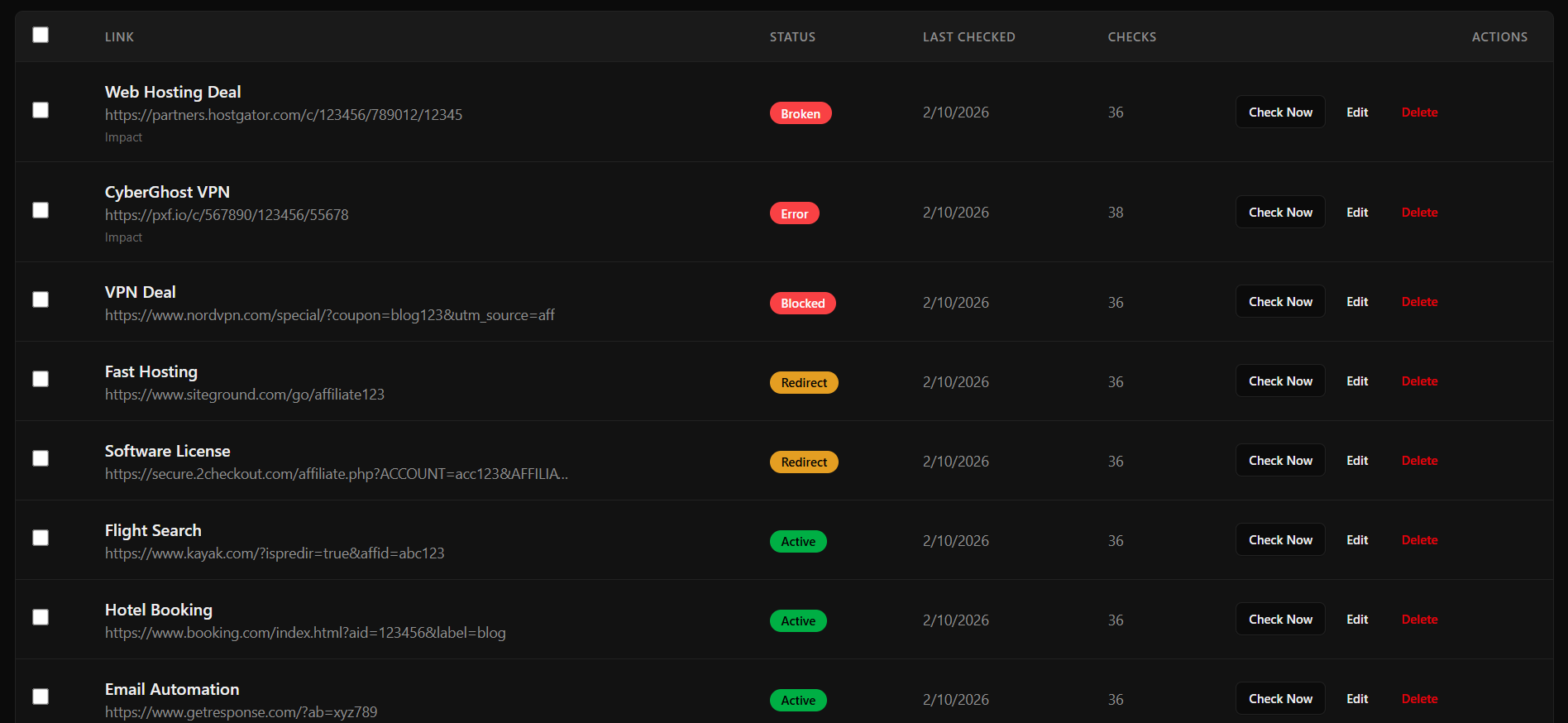
But if you have dozens or hundreds of links, manual checking doesn't scale. By the time you've checked every link on your site, some of the first ones you checked may have already broken again. Automated monitoring tools like AffilGuard check your links on a schedule and alert you when something breaks, so you can fix it the same day instead of discovering it months later.
The Bottom Line
Broken affiliate links aren't a minor inconvenience. They're a direct hit to your revenue that gets worse the longer you ignore them. The commissions you're losing today are the easy part — the compounding damage to your credibility, your content ROI, and your overall site health is what really adds up.
You don't need to check every link every day. But you do need a system that catches problems faster than you'd catch them on your own. A broken link found today is a five-minute fix. One that's been sitting there for three months is three months of traffic you already lost.

AffilGuard Team
We help affiliate marketers protect their commissions by monitoring links 24/7 and alerting you when something breaks. Our mission is to ensure you never lose money to broken affiliate links again.
Ready to Protect Your Affiliate Links?
AffilGuard monitors your links 24/7 and alerts you instantly when something breaks. Free for up to 20 links.
Related Articles
Affiliate Marketing Mistakes That Cost Real Money
Most affiliate revenue loss isn't caused by sudden disasters. It's caused by quiet, compounding mistakes that go unnoticed for months. Here are the ones that cost the most and how to fix each one.
Your Affiliate Links Aren't Converting (And It Might Not Be Your Content)
You optimized the headline, rewrote the CTA, and your traffic is solid, but conversions still dropped. Before you blame the content, check the link itself. Dead landing pages, stripped tracking parameters, slow redirect chains, and browser cookie restrictions are silently killing affiliate revenue across the industry.
Affiliate Link Cloaking: What It Is and When to Use It
Link cloaking is standard practice on most affiliate sites, but it introduces risks that rarely get discussed. Here's how it works, which networks allow it, which one will ban you for it, and what to watch out for.