Affiliate Program Changes That Could Kill Your Income

AffilGuard Team

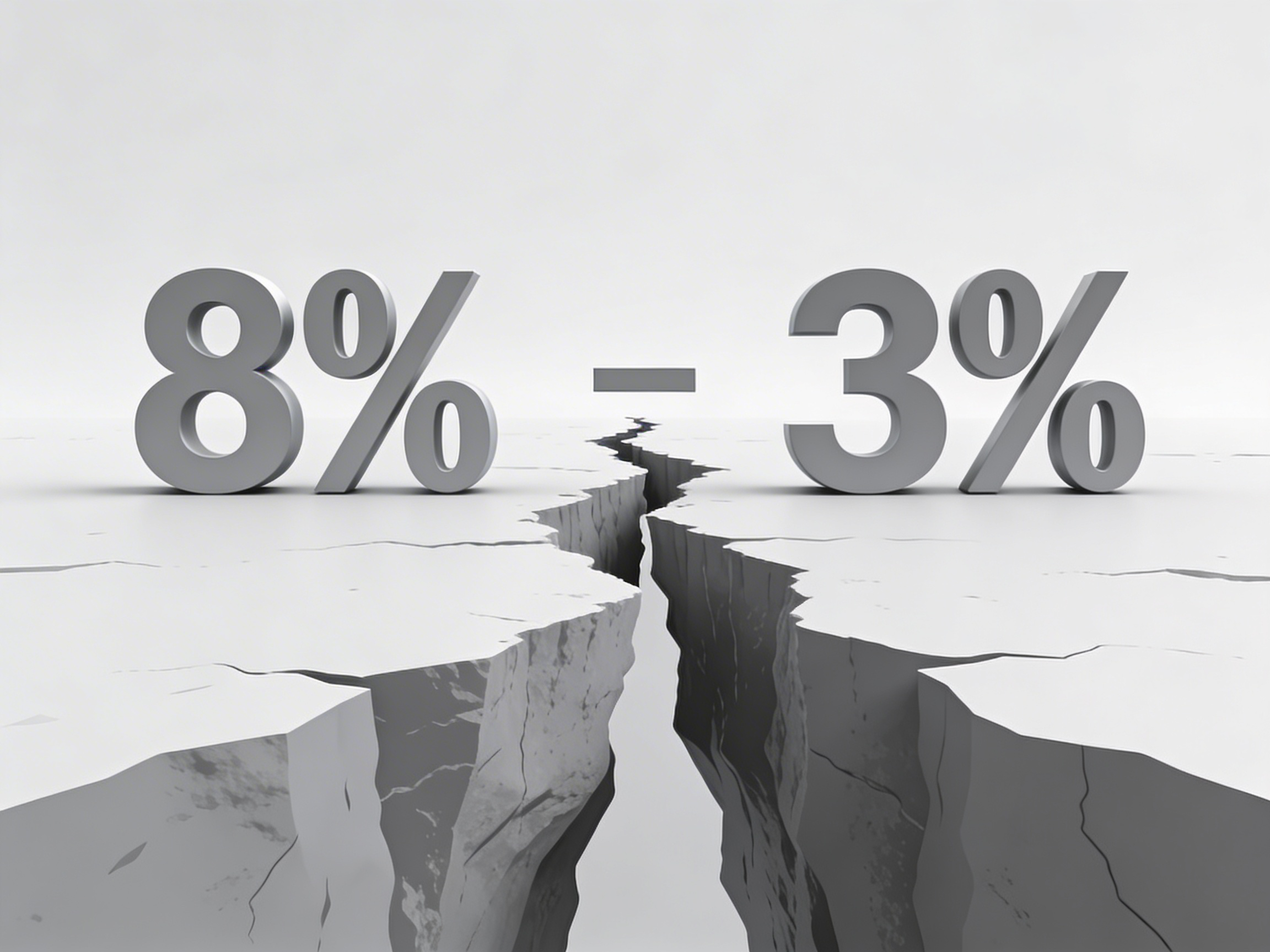
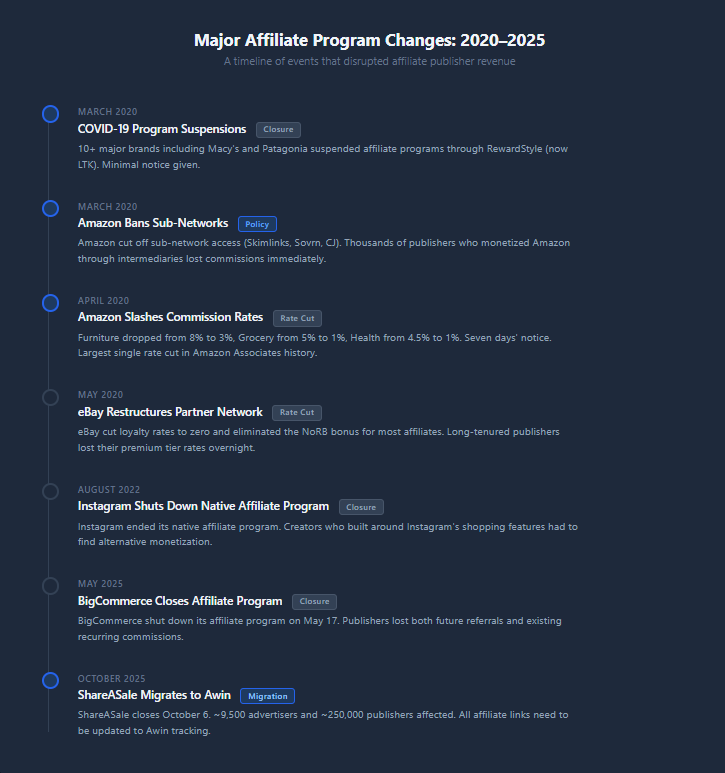
On April 14, 2020, Amazon sent affiliates an email with the subject line "Changes to the Associates Program advertising fee schedule." The changes took effect on April 21. One week of notice. Furniture commissions dropped from 8% to 3%. Grocery went from 5% to 1%. Health and personal care fell from 4.5% to 1%. If you were running a home decor review site that relied on Amazon for most of its revenue, you woke up to a 62% pay cut with barely enough time to read the email.
Amazon is not an outlier here. Affiliate programs change their terms constantly -- commission rates, cookie windows, allowed traffic sources, approved sub-networks, and whether the program exists at all. Most of these changes favor the merchant. And most of them arrive with little warning or none.
This article documents the biggest program changes from the last several years, explains the patterns behind them, and lays out a concrete plan for making sure a single policy update can't destroy your income.
Commission Rate Cuts: The Slow Bleed and the Sudden Drop
Rate cuts are the most common program change, and they come in two flavors. There's the gradual decline that you don't notice until you look back over several years, and there's the sudden slash that takes effect before you've had time to react.
Amazon illustrates both.
Amazon's Long Decline
Amazon had been cutting affiliate commission rates for years before the 2020 changes. Through incremental trims, category restructurings, and adjusted bonus tiers, each change was small enough that many affiliates absorbed it without changing strategy. But the cumulative effect was severe -- an Amazon affiliate link in 2020 was worth a fraction of what the same link had earned in 2012. The slow bleed meant most publishers never had a single moment where they reconsidered their dependence on the program.
The April 2020 Cuts
Then came the sudden drop. On April 14, 2020 -- weeks into the COVID-19 pandemic, with Amazon experiencing record demand -- the company slashed commission rates across its highest-volume categories:
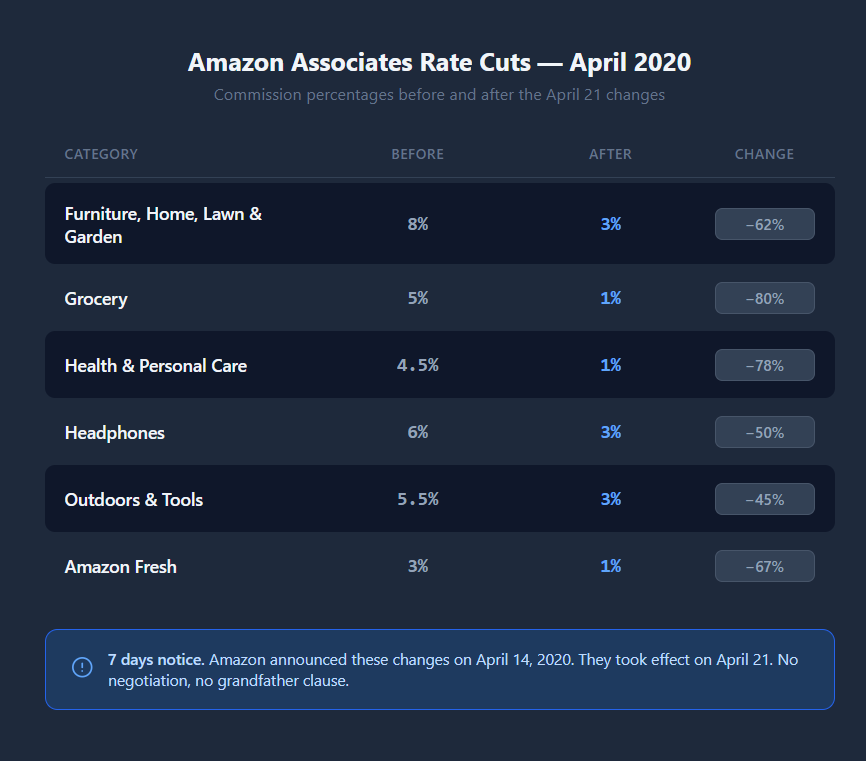
Furniture, Home, Lawn & Garden
8% → 3%
Grocery
5% → 1%
Health & Personal Care
4.5% → 1%
Headphones
6% → 3%
Amazon gave affiliates seven days of notice. No negotiation. No grandfather clause. The new rates applied to everyone in the program starting April 21 -- including any clicks that had already happened but hadn't yet converted.
The timing was particularly painful. The pandemic had driven a surge of online shopping, and affiliates were seeing record click volumes. Their traffic was up, but their per-conversion earnings had been gutted. Some affiliates reported that despite sending more traffic to Amazon than ever before, their monthly payouts dropped by 50% or more.
Why Amazon Can Do This
Amazon's Operating Agreement states that either party "may terminate this Agreement at any time, with or without cause," with 7 calendar days' written notice. Commission rates are set at Amazon's discretion and can be changed with as little as 2 business days' notice. There is no contractual obligation to maintain any specific rate for any duration. If you build on Amazon's platform, you build on Amazon's terms.
eBay Followed the Same Playbook
In May 2020, just weeks after Amazon's cuts, eBay restructured its Partner Network. The changes included cutting loyalty rates to zero and eliminating the NoRB (New or Reactivated Buyer) bonus for most affiliates. eBay had previously offered higher commissions to long-tenured publishers as a retention incentive. That incentive vanished overnight. Affiliates who had built eBay into their strategy specifically because of the loyalty tiers found themselves back at base rates with no transition period.
The pattern here is worth noting: when one major retailer cuts rates, others often follow within weeks or months. Amazon's cuts gave eBay cover to make similar reductions. When the biggest player in a market resets expectations, competitors rarely maintain higher payouts.
Program Closures: When the Whole Thing Disappears
Rate cuts are painful, but at least the program still exists. A program closure means every affiliate link you've placed -- across every page, every email, every YouTube description -- stops earning. The links might still work technically (sending readers to the merchant's site), but your tracking is dead.
BigCommerce (May 2025)
BigCommerce shut down its affiliate program on May 17, 2025. The program had offered generous one-time bounties (200% per referral) and had been a reliable option for publishers in the SaaS and e-commerce tool space. When it closed, every BigCommerce review, comparison page, and tutorial that contained an affiliate link was suddenly generating traffic for free.
Instagram Native Affiliate Program (August 2022)
Instagram shut down its native affiliate program on August 31, 2022. The program had allowed creators to tag products in posts and earn commissions directly through the Instagram app. When it closed, creators who had built their content strategy around Instagram's native shopping features had to scramble for alternative monetization -- either pivoting to external affiliate links (which Instagram makes deliberately inconvenient) or negotiating direct brand deals.
COVID-19 Suspensions (March 2020)
Program closures don't always come with a formal shutdown announcement. During March 2020, over ten major brands -- including Macy's, Ralph Lauren, and Victoria's Secret -- suspended their affiliate programs through RewardStyle (now LTK). These weren't small, niche programs. They were anchor partnerships for fashion and lifestyle publishers.
The suspensions came with minimal notice. Brands were cutting costs anywhere they could as physical stores closed and consumer spending became uncertain. Affiliate programs, which are entirely variable-cost marketing channels, were among the first line items to get paused. Some eventually reactivated, but the gap left affiliates without income for weeks or months.
What a Closure Actually Means for Your Site
When a program closes, your affiliate links don't automatically break -- they just stop tracking. Readers still click through to the merchant's site, but you earn nothing. Worse, you're still sending them qualified traffic. You're still doing the merchant's marketing for free. Unless you're actively monitoring your links, you might not realize a program has closed until you check your earnings dashboard days or weeks later.
Network Bans and Policy Changes
Sometimes the program itself doesn't change -- but the rules around who can participate in it do. Policy changes can remove entire categories of affiliates from a program with a single update.
Amazon Bans Sub-Networks (March 2020)
On March 31, 2020, Amazon banned sub-networks from its Associates program. Intermediaries like Skimlinks and Sovrn, as well as CJ Affiliate, had allowed publishers to monetize Amazon product links without maintaining their own individual Amazon Associates account. Thousands of publishers relied on these intermediaries.
When Amazon cut off sub-network access, any publisher who was linking to Amazon through one of these services lost their Amazon commissions immediately. The publishers themselves hadn't violated any rule. They hadn't changed anything about their sites or their content. Amazon simply decided that the intermediary layer was no longer acceptable, and every publisher downstream of that decision lost income.
For small and mid-size publishers, this was particularly disruptive. These intermediaries had made Amazon monetization simple -- no need to manage a separate Associates account, deal with Amazon's compliance requirements, or worry about Amazon's requirement that new accounts generate qualifying sales within 180 days. Suddenly, every one of these publishers needed to either apply for their own Associates account (with no guarantee of approval) or stop earning from Amazon links entirely.
Account Terminations
Beyond program-wide policy changes, individual account terminations are a constant background risk. Amazon's Operating Agreement gives them the right to terminate "with or without cause." In practice, common triggers include:
- Clicking your own affiliate links (even accidentally)
- Failing to make qualifying sales within 180 days of account creation
- Inadequate disclosure of the affiliate relationship
- Using affiliate links in offline materials, PDFs, or ebooks
- Link cloaking that obscures the destination URL
- Stating prices in your content (because prices change and Amazon considers outdated prices misleading)
The frustrating part is that Amazon doesn't always specify which rule you've violated. Termination emails often cite a general "not in compliance with the Operating Agreement" without pointing to the specific issue. And once terminated for a policy violation, your unpaid commissions may be forfeited.
Platform Migrations: When the Ground Shifts Under You
Even when a merchant stays committed to affiliate marketing, they sometimes switch the network that runs their program. When that happens, the disruption cascades down to every publisher.
ShareASale Closing, Migrating to Awin
ShareASale is closing on October 6, 2025, with all programs migrating to its parent company Awin. This affects approximately 9,500 advertisers and 250,000 publishers. It's one of the largest affiliate network migrations in history.
For publishers, a migration like this means:
Every link needs to be updated
ShareASale affiliate links use ShareASale's domain and tracking parameters. Once the migration completes, those links will eventually stop working. Every page on your site that contains a ShareASale link needs to be identified and updated with new Awin tracking URLs.
You need a new account (or account migration)
Publishers need to set up an Awin account if they don't already have one, or link their existing Awin account to the migrated programs. This isn't automatic. If you miss the migration window, you could lose access to programs you've been promoting for years.
Historical data may not transfer
Performance data, click history, and earnings reports from ShareASale may not carry over to Awin in full. If you rely on historical data for content optimization or tax records, you should export everything before the migration date.
Commission terms might change
A network migration gives merchants a natural opportunity to renegotiate commission terms. There's no guarantee that the rates you had on ShareASale will carry over to Awin unchanged.
If you have ShareASale links across hundreds of pages and you don't update them in time, those links go dead. You're still sending readers to the merchant, but you're not getting credited. This is exactly the kind of problem that a regular affiliate link audit is designed to catch.
The General Pattern
The ShareASale-to-Awin migration is unusually large, but merchants switch networks more often than most affiliates realize. A merchant might move from CJ to Impact, from Rakuten to Awin, or from a managed network to an in-house solution. Each switch creates the same set of problems: old links break, publishers need to re-apply, and there's a gap period where clicks aren't tracked.
The merchant's incentive is clear -- they might get better rates, better technology, or better support from the new network. The publisher's cost is equally clear: disruption, lost commissions during the transition, and the administrative burden of updating links across potentially thousands of pages.
Browser-Level Changes: The Threat No Program Controls
Not every threat to affiliate income comes from the programs themselves. Browser vendors have been steadily tightening restrictions on third-party tracking, and affiliate programs are collateral damage.
Safari's Intelligent Tracking Prevention (ITP)
Apple's Safari browser, which handles the majority of mobile web traffic on iOS devices, introduced Intelligent Tracking Prevention (ITP) to limit cross-site tracking. The impact on affiliate marketing is direct:
- JavaScript-set cookies (which many affiliate networks use) are capped at 7 days in Safari -- and can be further reduced to just 24 hours when the referring domain is classified as a tracker
- Cookies set via link decoration (URL parameters like
?ref=affiliateID) are capped at just 24 hours
What this means in practice: if a reader clicks your affiliate link on an iPhone, browses the merchant's site, leaves, and comes back 8 days later to make a purchase, the affiliate cookie is gone. The sale won't be attributed to you, even though you drove the initial visit.
This affects every affiliate program, not just specific ones. And it disproportionately impacts affiliates in categories with longer consideration periods -- electronics, furniture, travel, B2B software -- where customers rarely buy on their first visit.
Firefox has implemented similar restrictions, and Chrome has been moving toward its own set of privacy controls (though Google's timeline has shifted multiple times). The direction is clear: browser-level tracking restrictions are tightening, not loosening, and affiliate attribution is getting harder as a result.
Programs that rely exclusively on third-party cookies for attribution are the most vulnerable. Some networks have adapted by using server-to-server tracking or first-party cookie solutions, but adoption varies widely. If you're promoting programs that haven't updated their tracking technology, your Safari and Firefox conversions are likely being undercounted already.
How to Protect Yourself
You can't prevent program changes. You can't negotiate with Amazon's commission team or convince Apple to exempt affiliate cookies from ITP. What you can do is structure your business so that no single change can do catastrophic damage.
1. Diversify Across Programs, Networks, and Monetization Types
This is the most repeated advice in affiliate marketing, and it's repeated because it's the most important. If more than 40-50% of your affiliate revenue comes from a single program, you're one email away from a crisis.
Diversification means more than just "sign up for more programs." It means:
- Multiple affiliate programs in your niche, so that a rate cut or closure at one doesn't eliminate your income from that content
- Multiple affiliate networks, so that a network migration or policy change doesn't affect all your programs at once
- Non-affiliate revenue streams -- display ads, sponsored content, digital products, email monetization, or direct partnerships -- so that affiliate income is one component of your revenue, not the entire thing
The Amazon affiliates who survived the April 2020 cuts with minimal damage were the ones who had already been building out alternative programs. They weren't less affected by the rate change; they were less dependent on the rate staying where it was.
2. Build an Email List
An email list is the one audience channel that no platform, browser, or affiliate program can take away from you. When a program changes its terms, you can notify your audience about alternatives. When a program closes, you can redirect to a new recommendation. When cookies get blocked, you can drive repeat traffic through direct clicks that don't depend on stored tracking data.
Social media followers are rented. Search traffic is borrowed. An email list is owned. Build it from day one.
3. Monitor Your Programs Actively
Most affiliates find out about program changes one of two ways: they read the email (if they read affiliate program emails at all), or they notice a drop in earnings weeks later. Neither of these is fast enough.
Active monitoring means:
- Checking that your affiliate links still resolve correctly and that tracking parameters are intact
- Watching for changes in conversion rates that might signal a tracking issue or a program change you missed
- Verifying that cookie-based attribution is still working, especially for Safari and Firefox traffic
- Keeping a record of current commission rates so you can spot changes quickly
If you're managing more than a handful of affiliate relationships, doing this manually is impractical. Automated monitoring tools can check link health, flag redirects that have changed, and alert you when something breaks -- before it costs you weeks of lost commissions.
4. Read the Terms of Service (Actually Read Them)
Most affiliates accept terms of service without reading them, which is understandable -- they're long and written in legal language. But the terms contain the rules that will be used to justify any future change to your account.
At minimum, know the answers to these questions for every program you promote:
- Can the program change commission rates without advance notice?
- Can they terminate your account without cause?
- What happens to unpaid commissions if your account is terminated?
- What traffic sources are prohibited?
- Are there restrictions on how you can use affiliate links (cloaking, email, social media, paid ads)?
You're not reading the TOS to find a legal argument you can make if something goes wrong. You're reading it to understand how much risk you're carrying. A program that can terminate without cause and forfeit unpaid commissions is a different risk profile than one that requires 30 days' notice and pays out accrued earnings. Both might be worth promoting, but you should weight your content investment accordingly.
5. Keep Your Links Auditable
When a program changes -- whether it's a rate cut, a network migration, or a closure -- the first thing you need to know is: where on my site am I linking to this program? If the answer takes you more than a few minutes to figure out, you're going to lose money during the transition.
Maintain a system that lets you identify every page containing links to a specific program. Whether that's a link management plugin, a spreadsheet, or a monitoring tool, the ability to quickly find and update links is the difference between fixing the problem in an afternoon and losing commissions for weeks while you manually search through your content. A structured audit process makes this manageable even on large sites.
6. Export Your Data Regularly
Affiliate dashboards are not permanent records. When ShareASale closes in October 2025, publishers who haven't exported their historical data will lose it. When a merchant leaves a network, your performance reports for that merchant may disappear from the dashboard.
Export your earnings reports, click data, and conversion data on a regular schedule -- monthly at minimum. Store it somewhere you control. This data is useful for tax purposes, for tracking performance trends, and for proving your value to merchants when negotiating custom terms.
The Bigger Picture
None of this is meant to argue that affiliate marketing is dying or that it's not worth doing. The channel generates billions in revenue annually, and it remains one of the best ways for content creators to monetize recommendations.
But the structural dynamics of affiliate marketing create an inherent imbalance. Merchants set the terms. Networks enforce them. Publishers accept them or leave. There is no affiliate union, no collective bargaining, and no contractual protection against unilateral changes. The Amazon Associates agreement -- which lets Amazon change rates or terminate accounts at will -- is not an outlier. It's the standard.
The affiliates who build durable businesses are the ones who treat this reality as a design constraint, not a surprise. They diversify their income sources. They monitor their programs. They build direct relationships with their audience. And when the next email arrives announcing "changes to our commission structure," they have a plan that doesn't involve panicking.
Program changes are not a matter of if. They're a matter of when, and how badly they hit you when they arrive.

AffilGuard Team
We help affiliate marketers protect their commissions by monitoring links 24/7 and alerting you when something breaks. Our mission is to ensure you never lose money to broken affiliate links again.
Ready to Protect Your Affiliate Links?
AffilGuard monitors your links 24/7 and alerts you instantly when something breaks. Free for up to 20 links.
Related Articles
Affiliate Marketing Mistakes That Cost Real Money
Most affiliate revenue loss isn't caused by sudden disasters. It's caused by quiet, compounding mistakes that go unnoticed for months. Here are the ones that cost the most and how to fix each one.
Your Affiliate Links Aren't Converting (And It Might Not Be Your Content)
You optimized the headline, rewrote the CTA, and your traffic is solid, but conversions still dropped. Before you blame the content, check the link itself. Dead landing pages, stripped tracking parameters, slow redirect chains, and browser cookie restrictions are silently killing affiliate revenue across the industry.
Affiliate Link Cloaking: What It Is and When to Use It
Link cloaking is standard practice on most affiliate sites, but it introduces risks that rarely get discussed. Here's how it works, which networks allow it, which one will ban you for it, and what to watch out for.