Signs Your Affiliate Program Is Dying (Before They Tell You)

AffilGuard Team

In April 2020, Amazon cut affiliate commissions on furniture from 8% to 3%. Grocery dropped from 5% to 1%. The announcement came with about a week's notice. Thousands of affiliates woke up to find their expected earnings cut by more than half.
This wasn't random. Looking back, the signs were there. Amazon had been reducing affiliate commissions for years. They restructured from volume-based tiers to flat category rates in 2017, then made targeted cuts in 2019. The April 2020 slashes were just the latest step in a long decline.
Programs don't usually die overnight. They fade. And if you know what to look for, you can spot the pattern before it costs you too much.
The Slow Decline Pattern
Most affiliate programs follow a predictable arc when they're heading toward trouble. The changes come gradually, often with reasonable-sounding justifications, until one day you realize the program barely resembles what you signed up for.
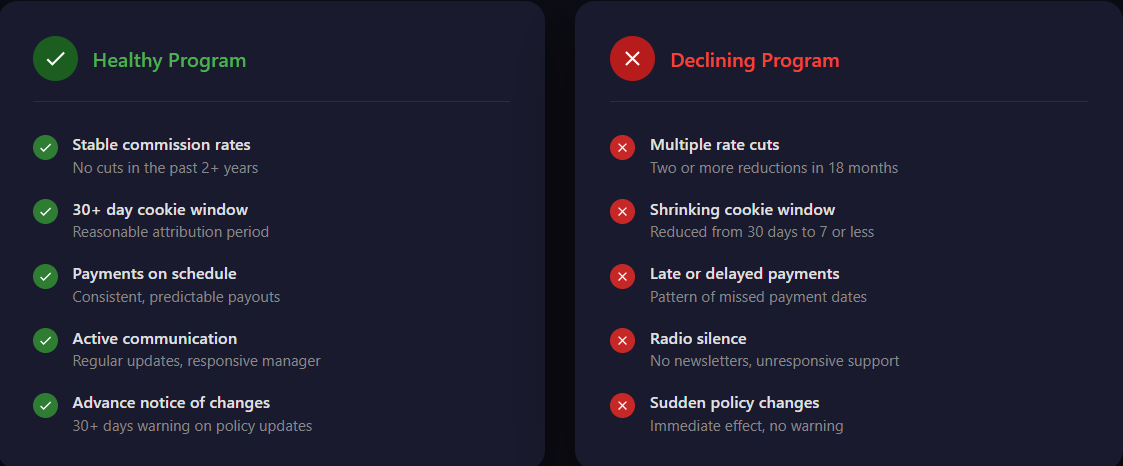
The timeline varies. Some programs take years to wind down. Others collapse in months. But the sequence of events tends to look similar.
Warning Sign: Commission Rate Cuts
This is the most obvious indicator, but affiliates often rationalize it away. A small cut doesn't seem worth abandoning a program over, especially if you're already earning well.
The problem is that cuts rarely come alone. Amazon's history shows this clearly. In 2017, they restructured their entire commission system, moving from a volume-based tier to flat category rates. Then came targeted reductions in 2019. Then the major cuts in 2020. Each one was positioned as a necessary adjustment. Together, they represented a fundamental shift in how much Amazon was willing to pay affiliates.
What to watch for
A single rate cut might be a one-time adjustment. Two cuts within 18 months is a trend. Start looking for alternatives when you see the second one, not the third.
Warning Sign: Cookie Window Reductions
Shortening the attribution window is a quieter way to reduce payouts. Instead of cutting your percentage, the program just makes it harder to earn that percentage.
Amazon's 24-hour cookie is the most famous example, but it wasn't always that short. When the program launched in 1996, the window was much longer. Over time, it shrank to what it is today.
When a program announces a shorter cookie window, the stated reason is usually about "aligning with industry standards" or "ensuring accurate attribution." The practical effect is fewer credited conversions. If your audience tends to research before buying, this change hits especially hard.
Warning Sign: Payment Terms Getting Worse
Changes to how and when you get paid can signal financial stress or decreasing investment in the affiliate channel.
Red flags include:
Longer payment cycles. Moving from monthly to every 45 or 60 days. This improves the merchant's cash flow at your expense.
Higher payment thresholds. Raising the minimum from $25 to $50 to $100. Smaller affiliates get squeezed out, and everyone waits longer for their money.
Unexplained delays. When payments that used to arrive on the 15th start showing up on the 20th, or the 25th, something is wrong. Occasional hiccups happen. A pattern of delays suggests the company is having trouble meeting its obligations.
Payment delays are serious
Late payments often indicate financial problems or that the company no longer considers the affiliate program a priority. Either way, it's time to diversify.
Warning Sign: Network Departures
When a merchant leaves an affiliate network entirely, or when a network cuts ties with certain affiliates, pay attention.
In recent years, Walmart terminated relationships with major affiliate platforms including Rakuten, Skimlinks, and MagicLinks. No public explanation was given. Amazon similarly cut off affiliate networks Skimlinks and Sovrn, forcing those networks' publishers to either apply directly to Amazon Associates or lose access entirely.
These moves usually mean one of two things: the company is trying to reduce what it pays in affiliate commissions, or it's consolidating control before making bigger changes. Neither is good news for affiliates.
Warning Sign: Less Communication
Healthy affiliate programs communicate. They send newsletters about new products, promotional opportunities, and upcoming changes. The affiliate manager responds to questions. There's some sense that the company values the relationship.
When communication drops off, it often means the company is reducing investment in the affiliate channel. The manager might have been reassigned. The budget might have been cut. Either way, a program that goes quiet is a program you should be watching closely.
Warning Sign: Terms That Allow Anything
Read the terms of service for any affiliate program and you'll find language like this:
Amazon's Associates Program Operating Agreement puts it plainly: they can modify any terms "at any time and in [their] sole discretion." The minimum notice period? Two business days. Your continued participation counts as acceptance. Your only alternative is to leave.
Most programs have similar language. The difference is how aggressively they exercise that right.
Programs that have historically provided advance notice of changes are more affiliate-friendly than those that announce changes effective immediately. Look at the program's track record, not just its current terms.
Real Examples of Programs Dying
It's not just rate cuts. Entire programs and networks have shut down.
Google Affiliate Network was one of the larger affiliate networks when Google shut it down in 2013. If Google decided the affiliate channel wasn't worth running, that should tell you something about how quickly priorities can shift. Thousands of merchants had to migrate their programs elsewhere, and affiliates had to reapply on new platforms or lose the relationship.
Travel programs have been particularly volatile. KAYAK, Qatar Airways, and Air France all terminated affiliate partnerships in recent years. Travel affiliates who had built content around those programs had to scramble for alternatives.
The point isn't to make you paranoid. It's to recognize that affiliate programs are business relationships, and businesses change direction. The programs that exist today won't all exist in five years.
What To Do About It
You can't prevent a program from declining, but you can protect yourself.
Diversify across programs. If one program represents the majority of your affiliate revenue, you're exposed. When Amazon cut rates in 2020, affiliates who had built their entire business around Amazon Associates were hit hardest. Those with multiple income sources adapted more easily.
Track program changes over time. Keep a simple record of commission rates, cookie windows, and payment terms for each program you use. When something changes, note it. Patterns become visible over time that aren't obvious in the moment.
Build relationships with alternatives before you need them. Don't wait until your primary program cuts rates to start looking at competitors. Apply to backup programs now, while you have leverage as an active affiliate with traffic to offer.
Monitor your links. A program in decline may stop maintaining its infrastructure. Tracking can break. Landing pages can go down. Redirect chains can start failing. Regular link monitoring catches these problems before they cost you too much.
Staying Ahead of the Curve
The affiliates who do best over the long term aren't necessarily the ones who pick the best programs. They're the ones who adapt when programs change.
That means paying attention. Reading the emails your affiliate programs send instead of archiving them. Checking your commission reports for unexplained drops. Noticing when a program that used to communicate goes quiet.
The warning signs are usually there. The question is whether you're watching for them.

AffilGuard Team
We help affiliate marketers protect their commissions by monitoring links 24/7 and alerting you when something breaks. Our mission is to ensure you never lose money to broken affiliate links again.
Ready to Protect Your Affiliate Links?
AffilGuard monitors your links 24/7 and alerts you instantly when something breaks. Free for up to 20 links.
Related Articles
How to Audit Your Affiliate Links (Step by Step)
Most affiliate marketers don't audit their links until something goes wrong. By then, commissions have already been lost. Here's a practical process for checking every link across your sites.
What Actually Happens When Someone Clicks Your Affiliate Link
A technical deep-dive into the journey of an affiliate click—from the moment someone clicks to when you get paid. Understanding this makes you better at the job.
How to Organize Your Affiliate Links (Without Losing Your Mind)
A practical guide to creating a system that keeps your affiliate links organized, accessible, and easy to maintain—whether you have 10 links or 1,000.